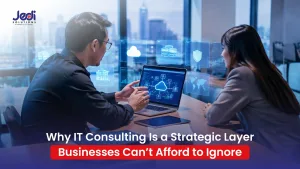
Cloud, cybersecurity, data, compliance, and digital transformation are making business IT environments increasingly complex. But adopting more technologies does not automatically make IT management more strategic.
The real challenge is knowing what to prioritize: which technologies the business actually needs, which risks need to be addressed, which controls need to be strengthened, and how each IT decision supports broader business goals.
IT Complexity Keeps Growing. Is Your IT Strategy Keeping Up?
As cloud, on-premises infrastructure, applications, and data are managed across different teams and environments, IT can become increasingly fragmented. At the same time, security and compliance requirements continue to evolve.
Without a clear direction, IT decisions can become reactive. A company may be able to resolve short-term technical issues, but that does not necessarily answer the bigger question: Is the current IT environment still aligned with the direction of the business?
A structured IT strategy helps businesses evaluate technology decisions based not only on technical requirements, but also on business priorities, operational risks, security, compliance, and long-term needs.
What Happens When IT Decisions Lack a Strategic Framework?
When IT decisions are made separately across teams or projects, several issues can arise:
- Fragmented IT governance: ownership, policies, and decision-making processes become less clear.
- Unidentified IT risks: security, operational, and infrastructure risks may go unnoticed.
- Compliance gaps: existing controls may not fully meet applicable regulations or standards.
- Suboptimal technology investments: resources may be allocated without clear consideration of business value.
- Misaligned IT initiatives: technology projects may move forward without a clear connection to business objectives.
While these may appear to be technical issues, their impact can extend to operational efficiency, risk exposure, compliance readiness, and the company’s ability to execute its business strategy.
IT Consulting: The Strategic Layer Between Business and Technology
So, what does IT consulting actually do? At its core, IT consulting helps businesses evaluate technology decisions within the broader context of business needs. The discussion goes beyond which technologies to implement and consider governance, risk management, compliance, and how each decision supports business objectives.
This approach connects business goals, IT strategy, governance, risk management, compliance, and technology execution with a clearer and more coordinated direction.
In other words, businesses can move beyond simply deciding which technologies to implement and gain a better understanding of the rationale, priorities, and risks behind each IT decision.
Why IT Audit Alone Is Not Enough
IT audit and IT consulting serve different purposes, but they can work together to support better IT management.
IT Audit: Identifying Gaps and Risks
IT audits assess an organization’s IT environment, controls, processes, and compliance against specific requirements or standards. This process can identify weaknesses, control gaps, and areas that require improvement.
As a result, businesses gain better visibility in the current state of their IT environment.
IT Consulting: Turning Findings into Improvement
IT consulting helps businesses understand what those findings mean for the organization and determine what should happen next.
For example, an audit may identify weaknesses in access control or IT governance. These findings can then be translated into improvement priorities, remediation strategies, governance changes, or technology initiatives that better fit business needs.
Simply put, an audit provides visibility into the current state of IT, while consulting helps define the path toward improvement.
What Can Strategic IT Consulting Deliver?
A structured IT consulting approach can help businesses:
- Strengthen IT governance with clearer policies, responsibilities, and decision-making frameworks.
- Manage IT risks by understanding technology risks and prioritizing mitigation based on business impact.
- Improve compliance readiness by identifying gaps against applicable regulations, standards, or certification requirements.
- Optimize IT management and resources by evaluating the effectiveness of existing processes, infrastructure, and resources.
- Align IT initiatives with business objectives, so technology investments and projects have a clearer direction.
The result is a more structured approach to IT decision-making, based not only on technical requirements but also on business priorities, risks, and expected value.
When Does a Business Need IT Audit & Consulting?
IT audit and consulting can become particularly valuable when a business is:
- Preparing for or maintaining ISO certification, including readiness assessments, certification audits, and surveillance audits.
- Addressing regulatory requirements by evaluating IT controls and processes against applicable requirements.
- Identifying security and compliance gaps before they develop into larger risks.
- Reviewing IT governance and controls to ensure existing policies and processes remain effective.
- Managing an increasingly complex IT environment, across infrastructure, applications, and data.
- Preparing for digital transformation with governance and risk frameworks that can support organizational change.
How Jedi IT Audit & Consulting Helps Strengthen IT Strategy
Jedi IT Audit & Consulting (JIAC) helps businesses assess their IT environment, identify gaps and risks, and develop recommendations to improve IT management, governance, security, and compliance.
JIAC’s capabilities include:
- IT Audit & Consulting
- IT Risk Management
- Audit Assistance
- Surveillance Assistance
- ISO 27001
- ISO 20000-1
- PCI-DSS
- Vulnerability Assessment & Penetration Testing (VAPT)
With an approach that covers both assessment and improvement, audit results do not have to stop at identifying findings. Businesses can use those findings as a basis for prioritizing improvements and strengthening their IT environment with greater direction.
The goal is not simply to build a compliant IT environment, but one that is better prepared to support business operations, manage risks, and adapt to future technology needs.
Build a Secure, Compliant, and Business-Ready IT Environment with Jedi
IT consulting becomes increasingly important when technology decisions go beyond day-to-day operational needs and start affecting business direction, governance, risk, and compliance.
By connecting strategy, governance, risk, compliance, and technology execution, businesses can make more structured IT decisions while building a stronger foundation for future change.
Looking to strengthen your IT strategy and environment? Connect with Jedi Solutions, part of CTI Group, to discuss your IT audit, consulting, risk management, security, and compliance needs.
Penulis: Wilsa Azmalia Putri – Content Writer CTI Group