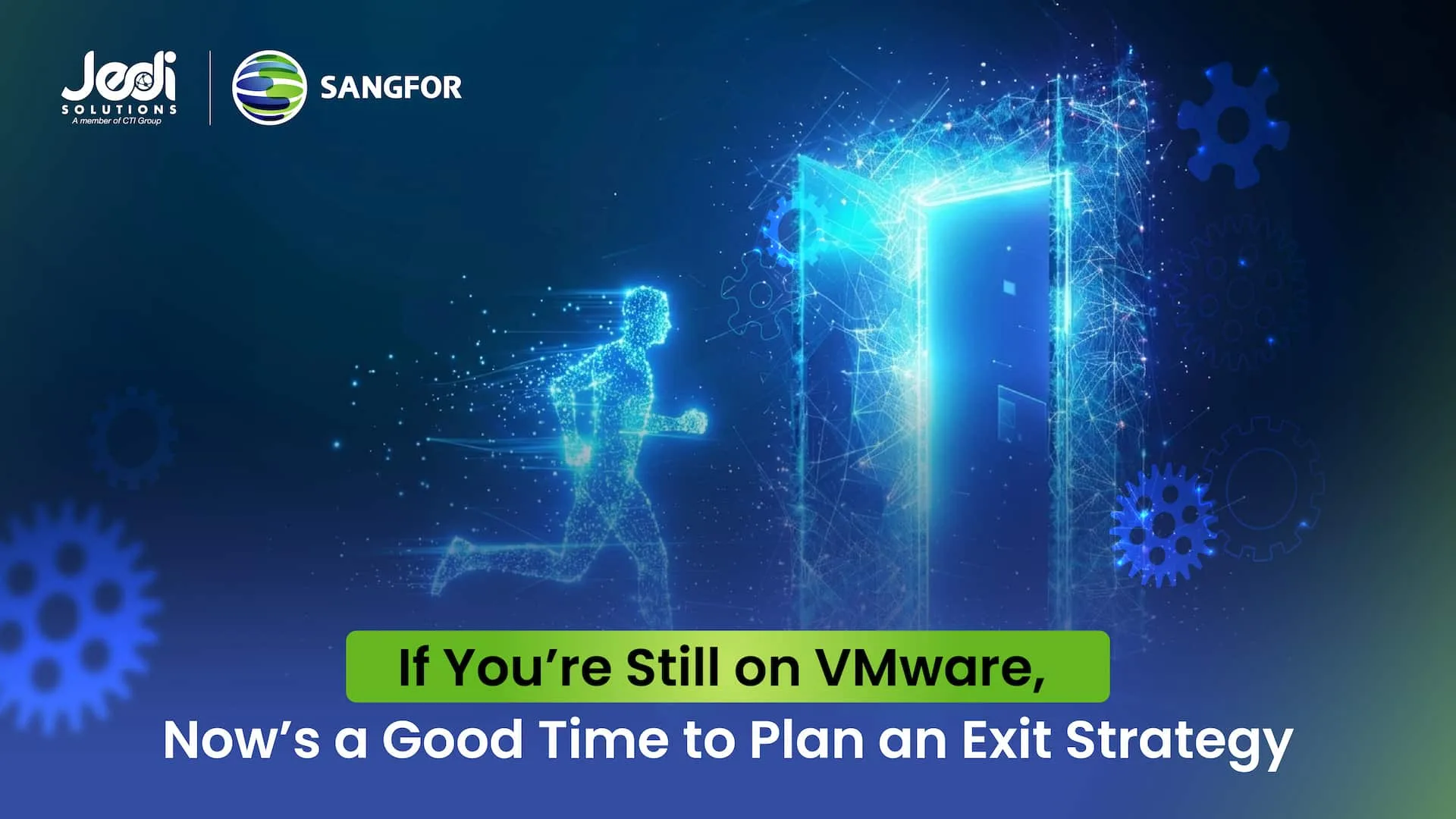
Over the past few years, more organizations have begun to question their long-standing reliance on VMware. Changes in licensing models, rising operational costs, uncertainty around long-term support, and increasing concerns about vendor lock-in have prompted IT teams to reassess whether their current infrastructure remains sustainable for the future.
These challenges have pushed many organizations to explore a VMware Exit Strategy as a forward-looking move. This approach is not merely about shifting workloads from one platform to another, but about ensuring a well-planned transition that maintains system performance, service availability, and business continuity throughout the process.
One alternative increasingly considered in this strategy is Sangfor Hyper-Converged Infrastructure (HCI). With its modern architecture, predictable cost structure, and end-to-end support, Sangfor HCI provides a flexible infrastructure foundation for organizations looking to reduce dependency on VMware without having to rebuild everything from scratch.
Why Are Many Organizations Re-Evaluating Their Use of VMware?
For years, VMware has served as the backbone of virtualization in many data centers. Today, however, organizations are re-evaluating their role, not because technology has failed, but because business and operational requirements have evolved.
Several key challenges are driving this reassessment.
1. Licensing Costs That Are Increasingly Hard to Predict
Recent changes in licensing models have made infrastructure costs rise and become more difficult to control, particularly for organizations operating in large and complex environments.
2. Growing Risk of Vendor Lock-in
A heavy dependence on a single ecosystem limits flexibility when adopting new technologies or adjusting IT strategies to align with evolving business needs.
3. High Operational Complexity
Managing VMware environments often requires multiple components, additional tools, and specialized expertise, adding pressure to IT teams, and increasing operational risk.
4. Limited Scalability for Modern Workloads
The shift toward hybrid architectures and cloud-native applications demands faster, more efficient scaling, something that has started to feel restrictive for certain organizations.
Taken together, these factors are encouraging companies to seek infrastructure approaches that are more cost-efficient, easier to manage, and still reliable enough to support mission-critical workloads.
Risks of Continuing to Depend on VMware
Staying with VMware is often seen as the safest option. However, without a clear VMware Exit Strategy, long-term dependence on a single platform can introduce risks that directly impact both day-to-day operations and long-term IT planning.
Some of the key risks that organizations should carefully consider include the following.
Rising Total Cost of Ownership (TCO)
Changes in licensing policies and subscription-based models have made infrastructure costs harder to control, reducing the budget flexibility needed to invest in innovation and future initiatives.
Dependence on the Vendor’s Roadmap
IT development direction and strategic decisions become heavily influenced by vendor policies, which may not always align with an organization’s evolving business priorities.
Limited Flexibility for Modernization
Relying on a single platform makes it more challenging, both technically and financially, to adopt hybrid architectures, cloud-native applications, and emerging technologies.
Uncertainty in IT and Budget Planning
Unpredictable costs and unclear product roadmaps complicate mid- to long-term planning, increasing the risk of unexpected expenses and potential operational disruptions.
For these reasons, a VMware Exit Strategy should be viewed not merely as a migration plan, but as a strategic initiative to regain control over IT infrastructure, from cost management and flexibility to the future direction of technology adoption.
Sangfor HCI as a VMware Alternative
In the context of a VMware Exit Strategy, organizations need more than just a replacement platform. They require a simple, stable, and flexible infrastructure foundation that can support long-term business needs. One of the most relevant alternatives is Sangfor Hyper-Converged Infrastructure (HCI).
Sangfor HCI is a modern virtualization platform that integrates compute, storage, and networking into a single, unified solution, enabling organizations to build a modern private cloud without the complexity of traditional infrastructure architectures.
As a VMware alternative, Sangfor HCI offers:
- A simpler and more efficient architecture that is easier for IT teams to manage
- A transparent and predictable licensing model that supports better budget planning
- More practical deployment and management without the need for multiple additional tools
- Enterprise-ready performance and availability, including support for mission-critical workloads
This approach allows organizations to reduce their dependence on VMware while maintaining system stability and performance throughout the transition.
How VMware Exit Strategy Is Executed with Sangfor
An effective VMware Exit Strategy requires a structured and phased approach. Sangfor HCI supports this process through three key stages designed to minimize risk while maintaining business continuity.
Assessment & Planning
The initial phase focuses on gaining a clear understanding of the existing VMware environment, including:
- Identification of critical virtual machines and applications
- Analysis of resource utilization and workload dependencies
- Prioritization of migration phases based on risk level and business impact
A well-executed assessment helps reduce potential disruptions and ensures a smoother transition throughout the migration process.
Migration & Compatibility
Sangfor is designed to support migration with minimal changes to existing environments:
- Minimum effort of application redesign required
- Support for both legacy and modern workloads
- Downtime can be kept to a minimum
This approach enables organizations to migrate gradually, without interrupting ongoing business operations.
Optimization & Operation
Once migration is complete, the focus shifts toward optimization and long-term operations:
- A simpler infrastructure that is easier to manage
- Centralized monitoring and management
- Resources can be scaled according to business needs
The result is an IT environment that is more efficient, stable, and ready to support future growth.
Key Advantages of Sangfor as a VMware Alternative
As a VMware alternative, Sangfor HCI offers advantages that are relevant for organizations of various sizes:
- Simpler and more cost-efficient licensing
- Centralized management with a user-friendly interface
- Built-in availability and security without extensive add-ons
- Flexible deployment for both enterprise and mid-sized businesses
These strengths position Sangfor HCI as a secure, well-planned, and sustainable solution for executing a VMware Exit Strategy with minimal risk.
Time to Move from VMware to Sangfor with Jedi Solutions
With the right VMware Exit Strategy, organizations can move beyond dependence on a single platform and build an IT foundation that is better prepared for future business demands. This approach enables organizations to achieve:
More controlled and predictable Total Cost of Ownership (TCO)
- A more flexible and scalable infrastructure aligned with business dynamics
- Greater IT operational efficiency with reduced complexity
- Lower vendor lock-in risk, allowing greater freedom in technology strategy
It is important to understand that an exit strategy is not about abandoning legacy technology, but about defining a more sustainable direction for future infrastructure. Changes within the VMware ecosystem make early evaluation and exit planning a strategic move, ideally undertaken before risks begin to impact operations.
With the right approach and alternative solutions such as Sangfor Hyper-Converged Infrastructure (HCI), organizations can transition safely, efficiently, and with minimal risk without compromising the stability of existing services.
As an implementation partner, Jedi Solutions, part of CTI Group, is ready to support every stage of your VMware Exit Strategy, from assessment and migration planning to Sangfor HCI implementation tailored to your business needs and scale.
Contact Jedi Solutions team to discuss and identify the most suitable solution for your IT infrastructure.
Author: Wilsa Azmalia Putri – Content Writer CTI Group