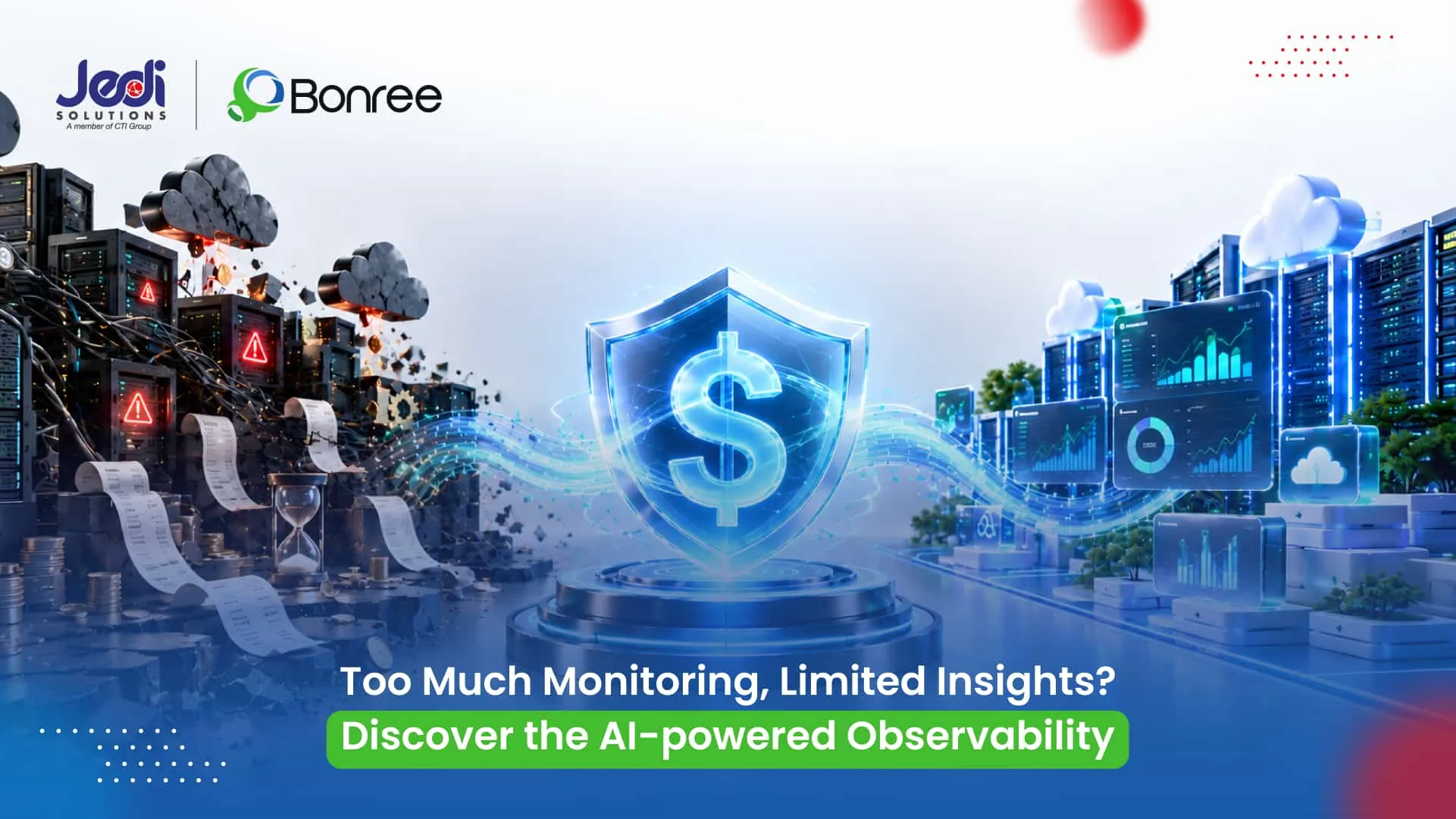
In today’s increasingly complex IT landscape, having heaps of monitoring data doesn’t necessarily mean better visibility. As applications, infrastructure, networks, and digital experiences generate massive amounts of data, IT teams often find themselves facing a new wave of challenges: endless alert noise, scattered tools, and painfully slow troubleshooting.
AI-powered observability plays a vital role by turning raw observability data into actionable insights. Without full visibility, the hidden costs of observability quietly creep in, showing up as operational complexity, excessive manual work, and degraded user experiences.
Why Monitoring Alone Isn’t Enough to Manage Enterprise IT

Traditional monitoring typically focuses on specific metrics and isolated system conditions. While this foundation remains essential, modern enterprise IT environments now span interconnected apps, infrastructure, networks, and digital services, making it tough to pinpoint problem context when viewing each component in a vacuum.
For enterprises, raw monitoring data simply isn’t enough anymore. IT teams need the ability to connect to disparate data sources for true end-to-end visibility. Without it, engineers waste precious time jumping between multiple tools just to understand a single incident.
3 Hidden Costs Enterprises Might Be Overlooking
The more systems to monitor, the more data and alerts flood in. If left unmanaged, observability ends up adding to your operational overhead rather than relieving it. Here are three common pitfalls:
1. Tool Sprawl
Relying on separate tools to monitor applications, infrastructure, networks, and digital experiences scatters visibility across multiple platforms. IT teams end up toggling between dashboards just to gather basic information.
2. Data Silos
Trapped data masks vital connections between system components. Yet, an issue in one layer can easily trigger a domino effect elsewhere. Without data correlation, investigations require far more manual effort and time.
3. Alert Fatigue
A surge of alerts doesn’t translate to better issue detection. When flooded with notifications, determining which alert demands urgent action becomes overwhelming. As a result, critical time that should go toward resolving issues is spent sifting through noise.
Shift from Basic Monitoring to Intelligent Observability
This is precisely why enterprises are embracing intelligent observability. Instead of merely gathering and displaying data, intelligent observability weaves together insights across every layer of your environment, giving your team a complete, unified view of system health.
Powered by AI, anomaly detection and root cause analysis become significantly faster. By correlating multi-source data, it helps teams understand event relationships, cut down alert noise, and dramatically speed up troubleshooting.
How AI Observability Transforms Incident Handling for IT Teams
AI takes observability to the next level by turning overwhelming data volumes into sharp, relevant insights. In AI observability, intelligent analytics work behind the scenes to spot anomalies, recognize patterns, and accelerate root cause analysis.
This approach is crucial for modern enterprise setups and AI-dependent applications. Integrating Application Performance Monitoring (APM) with AI-powered observability gives teams real-time visibility into app performance while providing full context across underlying infrastructure and networks.
Bonree ONE, A Unified Platform for End-to-End Intelligent Observability
To address these modern demands, Bonree ONE delivers integrated intelligent observability within a single platform. Offering end-to-end visibility across digital experiences, applications, infrastructure, and networks, it eliminates the need to analyze layers in isolation.
Bonree ONE brings together essential observability capabilities, including Digital Experience Monitoring (DEM), Application Performance Monitoring (APM), IT Infrastructure Monitoring (ITIM), and Network Performance Monitoring (NPM). Equipped with Intelligent Alerting, Root Cause Analysis, AI-powered Observability, data correlation, and unified visibility, the platform empowers teams to see how every layer connects.
The outcome is a far more proactive IT operation. Teams can detect issues faster, minimize manual investigations, and safeguard application performance alongside user experience.
Build Smarter IT Observability with Jedi Solutions
IT environments will only continue to grow in complexity alongside expanding apps, infrastructure, networks, and digital touchpoints. That’s why modern businesses need more than basic monitoring to gain holistic clarity and respond to incidents fast.
As your trusted enterprise IT and infrastructure solution partner, Jedi Solutions (part of CTI Group) helps businesses design and deploy tailored observability strategies powered by Bonree ONE.
Ready to see how AI-powered observability can elevate your IT environment? Discuss your business needs with Jedi Solutions today.
Author: Angela Merici Retna Perwitasari
Content Writer Intern CTI Group