
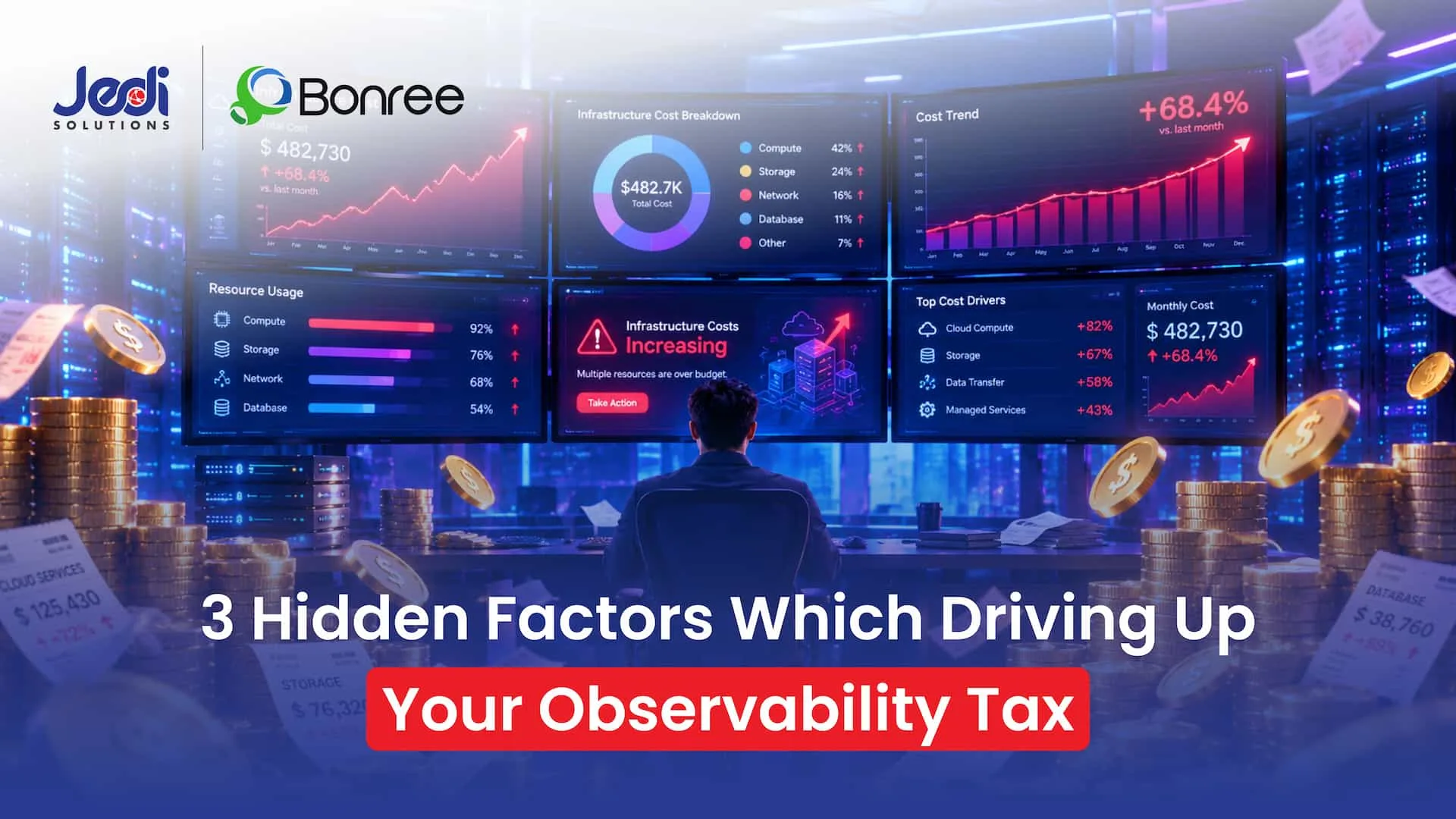
Monitoring should help IT teams understand what is happening across their systems. However, when applications, cloud, networks, databases, Kubernetes, and digital experience are each monitored using different tools, broader visibility can come with another consequence: rising costs.
This is known as observability tax, the cost that arises when observability needs grow faster than a company’s ability to manage its data, tools, and complexity. The issue is not simply how much a platform costs, but how much a company needs to spend to maintain its entire observability stack.
<h2> More Tools Do Not Necessarily Mean More Insights </h2>
In modern IT environments, applications rarely operate in isolation. Application performance, infrastructure, networks, cloud, databases, and user experience are all interconnected. As a result, teams need comprehensive visibility to understand how a single issue can affect the overall service.
The problem arises when each layer has its own observability tools. Teams have to switch between dashboards to find information, connect data manually, and determine whether an alert is actually important. The more tools they use, the greater the operational complexity they have to manage.
<h2> Observability Costs Can Be Higher Than They Appear </h2>
When discussing observability costs, companies often look only at platform subscription or licensing fees. However, observability tax can also come from data volume, telemetry storage requirements, the number of tools, integrations, and the time teams spend managing them.
The more workloads and infrastructure that are monitored, the more data needs to be processed and stored. Without the right strategy, companies may end up paying for data they do not actually need while also dealing with alert fatigue caused by an overwhelming amount of information without clear prioritization.
On the other hand, traditional monitoring that looks at each component separately makes it difficult for teams to understand the relationship between infrastructure issues, application performance, and user experience. This makes full-stack observability increasingly relevant for connecting visibility from end-user experience to back-end infrastructure within a single context.
<h2> What Is Actually Making Observability More Expensive? </h2>
As IT environments become more complex, observability costs do not come solely from the platforms being used. There are several other factors that are often overlooked but can gradually drive up observability tax.
<h3> 1. More Data, Higher Costs </h3>
The more systems that are monitored, the greater the volume of telemetry generated. Logs, metrics, traces, events, and performance data can continue to grow, driving up processing and storage requirements.
The challenge is determining which data actually delivers value. Companies need broad visibility without having to pay a high price for every piece of data coming in without proper control.
<h3> 2. One Problem, Five Dashboards </h3>
Using multiple tools may seem like a way to achieve more comprehensive monitoring. However, every tool comes with its own dashboard, configuration, integration, and workflow that needs to be managed.
Ultimately, teams are not only dealing with tool sprawl. Incident resolution also takes longer because information is scattered across different tools. Unified observability can reduce the need to switch between tools and dashboards by centralizing visibility on a single platform.
<h3> 3. When Your Choice of Tools Limits Your Flexibility </h3>
Dependence on a particular platform can also make it more difficult for companies to change their strategy as their environment evolves. This risk is especially relevant for organizations running a combination of on-premises, private cloud, public cloud, Kubernetes, and container environments.
An enterprise observability platform needs to be flexible enough to adapt to evolving IT architectures rather than tying companies more closely to a single ecosystem.
<h2> AI Is Changing How Teams Interpret System Signals </h2>
AI is changing how teams make sense of observability data. Alert correlation, anomaly detection, bottleneck identification, and root cause analysis can help filter incoming information, allowing teams to identify and prioritize incidents more quickly. This approach also supports the shift from reactive monitoring to proactive IT operations through more predictive insights.
The growth of AI-based workloads is also making IT environments increasingly complex and dynamic. Applications, infrastructure, networks, and cloud environments are interconnected, creating a need for visibility that can connect these components within a single context.
This is where AI-powered observability plays a role in helping teams identify patterns, detect anomalies, and understand operational impact more quickly.
<h2> Discover a More Integrated Enterprise Observability Platform with Bonree</h2>
Observability costs rise when data is fragmented, dashboards multiply, and incident investigations take too long. Bonree unifies application, infrastructure, cloud, network, and digital experience monitoring in a single platform, enabling IT teams to monitor system health without switching between multiple tools.
With AI-powered alert correlation and anomaly detection, IT teams can identify root causes faster, prioritize critical incidents, and reduce troubleshooting time. This means less manual work, faster incident response, and more time to focus on service reliability rather than managing disconnected tools. By streamlining operations, Bonree helps control the observability tax while improving IT efficiency.
<h2> Build a More Efficient Observability Strategy with Jedi Solutions </h2>
Building the right observability strategy requires an understanding of infrastructure needs, IT architecture, and the complexity of the environment in use. Observability solutions should be selected based on how different IT layers can be monitored in an integrated, efficient, and flexible way.
Jedi Solutions, part of CTI Group, helps companies understand their observability needs and connect them with the right Bonree solutions.
Want to learn how unified observability can help reduce monitoring complexity and control observability tax in your organization? Consult with Jedi Solutions about your observability needs.
Author: Angela Merici Retna Perwitasari
Content Writer Intern CTI Group