
WhatsApp has evolved from a simple messaging tool into a primary channel for banking, FSI, manufacturing, and retail sectors to manage sales, marketing, and customer support.
However, manual WhatsApp management often becomes an operational bottleneck. Slow responses, inconsistent follow-ups, and fragmented data could hinder growth and lead to the loss of valuable insights. In today’s fast-paced market, these conventional methods risk stalling your business scalability.
How can businesses overcome these hurdles? Find the solution in this article.
The Limitations of Manual WhatsApp in Business Operations
Managing WhatsApp without automation may still work when message volume is low. But as your business grows, several challenges start to emerge, such as:
1. Not Scalable
As the number of incoming chats increases, so does the workload for your team. Each conversation requires a timely response, yet everything still depends on manual handling by handling admins or agents. This often leads to overwhelmed teams, especially during peak hours.
2. Risk of Missed Leads
Missed messages often mean missed revenue opportunities. Today’s customers expect quick responses, and even slight delays can push them toward competitors.
3. Scattered Customer Data
Customer information is often spread across WhatsApp, Excel, and email, without a single source of truth. This makes it difficult to track interaction history or the latest customer status, leading to inconsistent follow-ups and potential data loss.
4. Limited Visibility and Insights
Without an integrated system, businesses lack clear visibility into the customer journey. Teams struggle to identify where customers drop off or need attention, and performance becomes difficult to measure due to incomplete data.
Turning Conversations into Action with Cognitive Automation
At this point, WhatsApp alone is no longer sufficient. Businesses need a smarter system to manage communication effectively. This is where cognitive automation comes in, a technology that not only automates tasks but also understands context, processes data, and makes decisions automatically.
In manual processes, everything relies on human effort, while basic automation only follows predefined rules such as auto-replies or broadcasts.
Cognitive automation, on the other hand, works more intelligently. It can understand conversations, process data from multiple sources, and execute workflows based on context and conditions. It also integrates seamlessly with systems like CRM, email, and databases.
Why Cognitive Automation Must Be Integrated with CRM?
One of the key success factors in implementing cognitive automation is integration with a CRM (Customer Relationship Management) system. A CRM acts as a centralized hub for customer data, storing interaction history, customer information, and lead or pipeline status in one place.
Without CRM integration:
- Data remains scattered
- Communication becomes less personalized
- Follow-ups are ineffective
- Decisions are not data-driven
Automation without data only accelerates inefficiency. With proper integration, businesses gain a complete and actionable view of their customers.
How Cognitive Automation Works with CRM Integration?
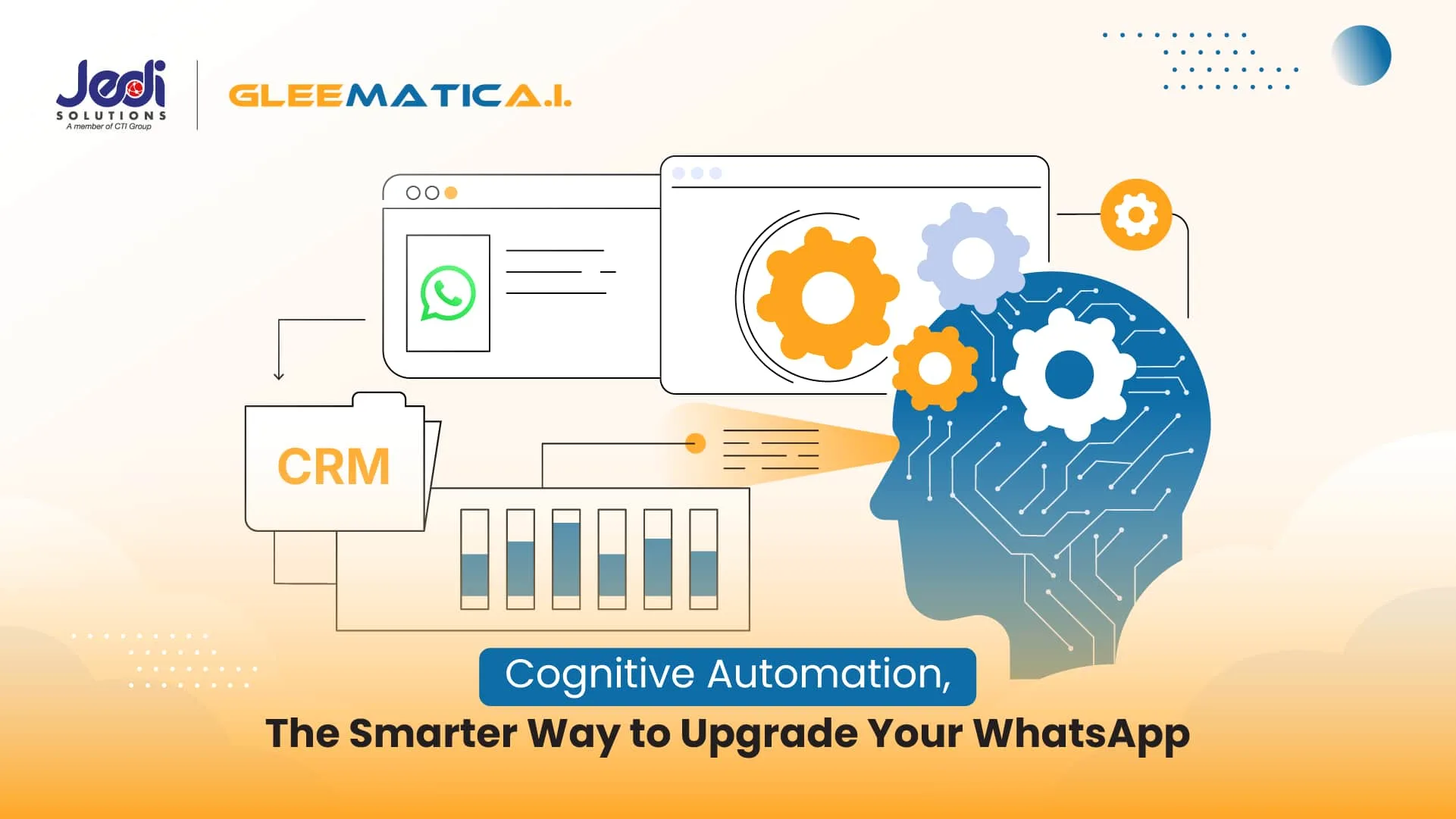
At a high level, cognitive automation connects conversations directly to business data and workflows. With CRM integration, every interaction is instantly processed into actionable data.
Here’s how it works:
- Customers reach out via WhatsApp
- The system reads and understands the message
- Data is automatically captured into the CRM
- Workflows are triggered (lead assignment, follow-ups, etc.)
- All activities are recorded and can be analyzed
As a result, business processes become faster and more efficient, with minimal manual intervention and more structured data. This is why a WhatsApp automation tool becomes essential for modern businesses.
Key Benefits of Cognitive Automation for Businesses
Beyond improving operational efficiency, cognitive automation transforms how businesses respond to and understand customers. With integrated, data-driven processes, every interaction becomes faster, more consistent, and more relevant.
Some of the key benefits include:
- Reduced manual work
- Minimized human error
- Faster response times
- Better resource optimization
- Increased conversion rates
- Improved customer experience
Real Use Cases of Cognitive Automation in Business Operations
To gain a clearer picture of its impact, here’s how cognitive automation is implemented in real business scenarios:
1. Automated Lead Management
Customer data is instantly captured in the CRM and automatically assigned to the sales team, ensuring no leads are missed and response times are faster.
2. Follow-Up and Nurturing
The system sends reminders and follow-ups automatically based on lead status, ensuring consistent and timely communication.
3. Customer Support
Common inquiries are handled automatically, while more complex issues are escalated to agents with complete conversation history already available.
4. Campaign and Retargeting
Messages are sent based on customer segmentation, making campaigns more targeted and personalized.
Maximize Business WhatsApp with Gleematic AI
As business operations become increasingly complex, manual WhatsApp handling and basic automation without data intelligence are no longer sufficient. Businesses today require a solution that can seamlessly manage both data and workflows in an integrated way.
Gleematic AI delivers a cognitive automation solution integrated with CRM systems, enabling every conversation to be managed end-to-end and driven by data. With rapid implementation and strong integration capabilities across various systems, businesses can improve operational efficiency while driving more measurable and scalable growth.
Shift to Smarter, More Efficient Operations with Jedi Solutions
With a more integrated and data-driven approach, WhatsApp is no longer just a communication tool. It becomes a critical part of a system that drives operational efficiency and business growth.
Together with Jedi Solutions, part of CTI Group, this transformation is enabled through cognitive automation solutions that help organizations manage conversations in a fully end-to-end and data-driven manner.
Contact the JEDI team now and discover how your business can move faster, operate smarter, and stay ahead in an increasingly competitive digital landscape.
Author: Angela Merici Retna Perwitasari
Content Writer Intern CTI Group